

Can an EPS 3D Panel Line Supplier Meet Project-Wide Certification Requirements?
When an EPS 3D panel plant is being planned, certification questions often appear after the production capacity and machine layout have already been discussed. A buyer may have a line quotation, a factory location, and an installation schedule, but then discover that the project also needs electrical compliance documents, safety records, material traceability, panel performance evidence, utility approvals, or local acceptance inspections. At that point, the concern becomes much larger than whether one machine has a certificate.
Can an EPS 3D panel line supplier meet project-wide certification requirements? A capable supplier can support a large part of the process, but no responsible supplier should promise to independently certify every element of an entire project. Project-wide compliance normally involves the equipment supplier, the buyer, local installers, electrical contractors, civil engineers, material providers, and sometimes inspection authorities. The practical goal is to choose a supplier that can provide clear equipment documentation, design the line around applicable requirements, identify responsibility boundaries early, and cooperate during installation and commissioning.
Certification is rarely limited to the EPS 3D panel machine
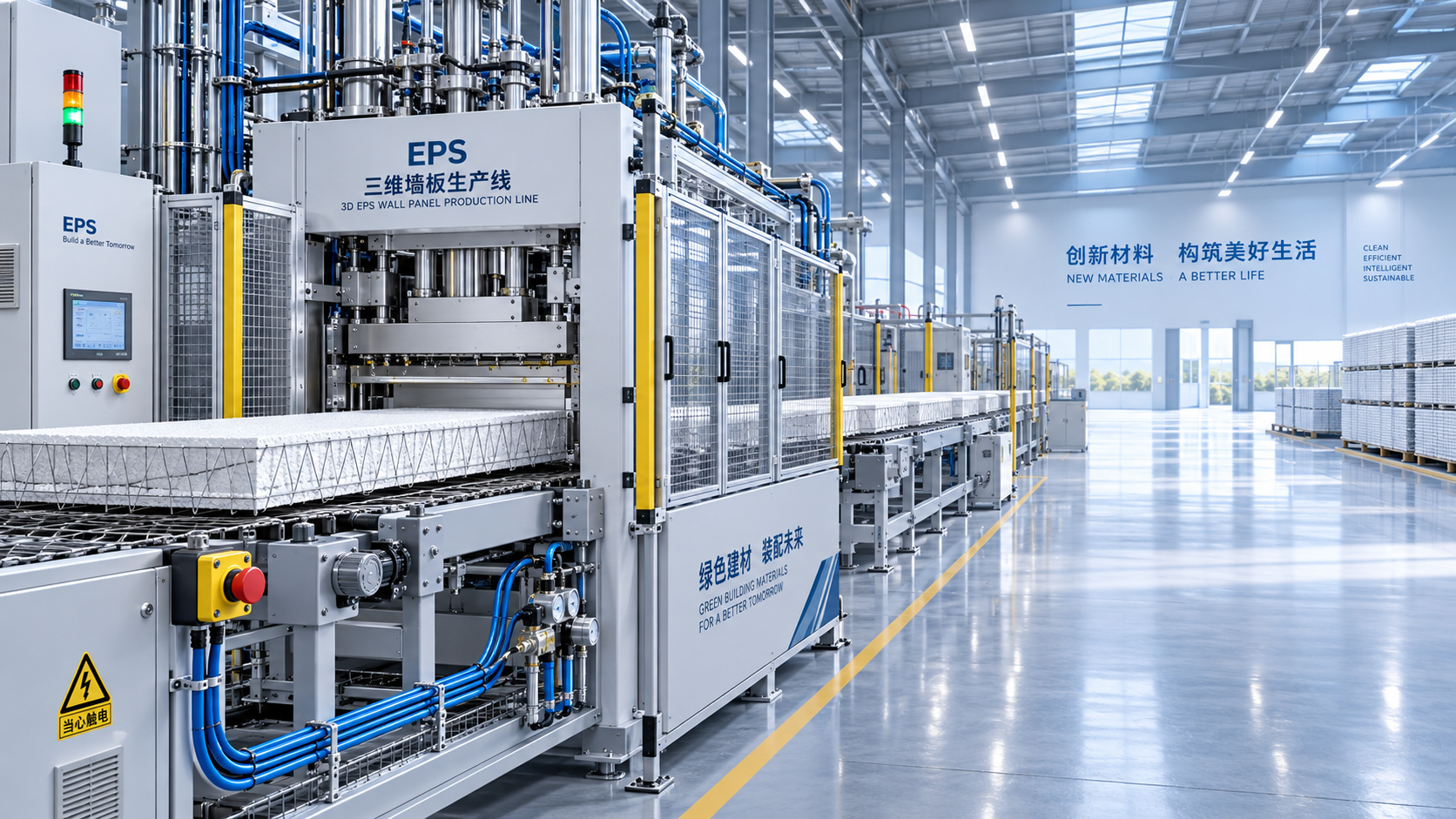
An EPS 3D panel production line is not one isolated unit. It usually includes material handling, EPS processing equipment, molding or forming sections, mesh or wire handling equipment where applicable, conveying systems, cutting equipment, control cabinets, pneumatic or hydraulic systems, safety guards, and supporting utilities. Each part may create a separate compliance question.
For example, a production line may meet the buyer's intended operating specifications, yet the project can still be delayed because the local power supply arrangement has not been approved, the emergency-stop circuit does not match site expectations, or the building’s fire and ventilation design has not been finalized. These issues do not necessarily mean the machinery is unsuitable. They show why a project-wide certification plan must begin before manufacturing and shipment.
It helps to divide requirements into four practical groups:
- Machine compliance: equipment design, guarding, electrical components, control-system safety, manuals, labels, and factory testing records.
- Production-process compliance: operating procedures, product consistency controls, material handling, recycling arrangements, and quality records.
- Factory and utility compliance: power distribution, compressed air, steam or thermal systems where used, drainage, ventilation, fire protection, and building approvals.
- Finished-panel compliance: the final EPS 3D panel may need to satisfy construction, insulation, structural, fire, or market-entry requirements that depend on its exact design and intended application.
Confusion arises when these categories are treated as one supplier obligation. A line supplier may be well positioned to document and support the first two categories, while the local project team usually has a central role in the third. The fourth often requires coordination among the panel design owner, raw-material suppliers, testing bodies, and the manufacturer operating the line.
Start with the approval path, not the equipment list
The most efficient approach is to ask what must be accepted before the line is ordered. This changes the conversation from “Does the machine have certification?” to “What documents and inspections will this project require, who will provide them, and when?” That distinction prevents late requests for information that was not included in the original scope.
Before technical specifications are frozen, prepare a requirement register. It does not need to be a complicated legal document. A working table can identify each requirement, the responsible party, the evidence needed, the review stage, and whether local adaptation is necessary.
A supplier should be able to review this register against the proposed line configuration. Some requirements can be incorporated directly into the design, such as requested electrical arrangements, machine guarding provisions, labeling language, or documentation format. Others must be handled by local specialists because they depend on the actual building, local grid, piping route, and authority having jurisdiction.
What a supplier should be able to provide
A credible EPS 3D panel line supplier does not need to act as the final approval authority to be useful in a certification-driven project. Its value lies in supplying accurate, consistent technical information that allows the rest of the project team to complete their work without guesswork.
Ask for documentation that is specific to the quoted line rather than general brochures. The most useful package often includes a machine layout, process flow, equipment list, installed and operating power information, utility requirements, electrical schematics, pneumatic or hydraulic diagrams if relevant, operating manuals, maintenance guidance, spare-parts information, and commissioning records. The exact list will vary, but the documents should agree with one another. A power figure in the quotation that differs from the electrical drawing, for instance, can create unnecessary review delays.
Safety design should also be discussed in physical terms. Rather than accepting a broad statement that the line is “safe,” examine where people load materials, remove products, adjust mesh, clear jams, change cutting components, perform maintenance, and access elevated or enclosed areas. These are the moments when safety requirements become concrete. Guards, doors, emergency stops, lockable isolation points, warning labels, and operator access need to match the actual layout of the factory.
NKL’s turnkey EPS factory planning experience can be relevant here because line design, utilities, installation, commissioning, and operator training are connected activities. For a buyer, the important point is not a generic turnkey claim; it is whether the supplier can translate the selected EPS 3D panel line into usable layout and utility information early enough for local engineering and compliance review.
Finished-panel requirements must be separated from line capability
A frequent mistake is assuming that certification of machinery automatically proves compliance of every panel produced by that machinery. It does not. The equipment contributes to repeatability, dimensional control, bonding conditions, cycle stability, and traceable operating parameters. However, finished-panel performance can depend on EPS density, raw-material formulation, reinforcement or mesh configuration, panel thickness, facing materials, curing or handling conditions, and the intended building application.
This matters when a project is intended to manufacture panels for a market with defined construction requirements. The buyer should identify the exact panel family before asking the line supplier to confirm suitability. A broad description such as “3D wall panel” may cover several designs with different structural and fire-related expectations. The equipment supplier needs dimensions, material arrangement, output targets, and process assumptions in order to determine whether the proposed line can consistently produce that configuration.
Where independent testing or product approval is required, build that activity into the launch plan. Do not wait until the factory is completed and full commercial production is expected. Trial production, sample preparation, quality records, and any required testing sequence can take time. The line supplier can support parameter setup and stable production, but it should not be expected to guarantee an approval outcome that depends on materials, product design, local rules, and third-party evaluation.
Questions that reveal whether a supplier is prepared
During supplier discussions, broad questions tend to receive broad answers. More useful questions focus on deliverables and boundaries.
- Can the proposed line be configured for the site’s voltage, frequency, control requirements, and available utilities?
- Which drawings will be issued before shipment, and which will be finalized during installation?
- Can the supplier identify all major utility connection points and expected consumption conditions?
- Which safety devices are included as standard, and which site-specific protections remain outside the machine scope?
- How will the line be tested before delivery, and what acceptance records can be provided?
- What information is needed from the buyer to confirm panel dimensions, reinforcement arrangement, production sequence, and changeover needs?
- Can the supplier support installation, commissioning, and operator training in a way that creates usable handover records?
- Which compliance tasks require a local licensed contractor, engineer, inspector, or testing organization?
Clear answers should name documents, interfaces, and responsibilities. Be cautious when a supplier offers an unrestricted statement that “all certification is included” without asking where the plant will be installed or what panel specification will be produced. Requirements differ significantly between markets and even between sites in the same market.
Control changes during installation
Even a well-documented machine can lose compliance alignment when site modifications are made without review. A control cabinet may be relocated, a guard may be removed to create more aisle space, an emergency stop may be added by a contractor without integration into the existing safety circuit, or a utility connection may be resized because the original routing was inconvenient. Each change can affect operation, maintenance access, safety, or local inspection.
Keep a controlled record of site changes. This can be simple: record the original drawing, the reason for the change, the person approving it, the revised drawing or photograph, and the completion date. The objective is not administrative burden. It is to ensure that the final installed line matches the documentation used for commissioning and future maintenance.
Commissioning should include more than proving that panels can be produced. The handover process should verify directional rotation, sensor operation, safety-device response, utility stability, material flow, operating parameters, alarm functions, and operator understanding. Any outstanding item should be documented with an owner and target completion point. A rushed startup can create problems later when an inspector, insurer, maintenance technician, or new production supervisor needs to understand how the system was configured.
Questions buyers often ask
Can one certificate cover the entire EPS 3D panel factory?
Usually not. Equipment, factory construction, electrical installation, utilities, worker safety, and finished products may be assessed under different processes. The practical objective is a coordinated documentation package and a clear division of responsibility, not a single document that claims to cover every project element.
Should certification requirements be discussed before ordering the line?
Yes. Early discussion allows the supplier to account for electrical conditions, layout restrictions, documentation needs, safety provisions, and product configuration before fabrication begins. Retrofitting these items after shipment is often more difficult and may disrupt the startup schedule.
Is a turnkey supplier automatically responsible for local approvals?
Not automatically. A turnkey scope can cover planning, equipment supply, installation support, commissioning, and training, but local approvals may still require documents or sign-off from locally qualified parties. The contract should state exactly what the supplier will provide and what the buyer must arrange.
What is the most important document to request first?
Begin with a project-specific technical proposal that defines the equipment scope, process flow, layout assumptions, utilities, electrical basis, safety scope, and expected documentation. It gives local engineers and compliance personnel a foundation for identifying gaps before the order is finalized.
The supplier that best supports project-wide certification is not necessarily the one making the broadest promise. It is the one willing to examine the intended installation, provide line-specific technical records, identify where local expertise is required, and maintain consistency from factory planning through commissioning. That approach gives an EPS 3D panel project a more realistic path to compliance, stable operation, and an orderly handover.
Send Us A Message